The short version: Hela is not a game about winning fights. It is a game about reading a physical space, moving through it cleverly, and noticing what a second pair of paws could do. If you spend your first hour learning that grammar, the rest of the forest opens up.
Start with the right expectation
Windup describes Hela as a wholesome open-world adventure. The important word is open: the game is built around exploration, foraging, physics puzzles and small acts of kindness, not combat, loot rarity or a damage number that goes up.
There is no health bar. There is no death state. Owls and foxes can catch a mouse, but the witch’s magic returns you to safety rather than ending the run. Falling does not hurt you either. The cost of a mistake is time, not progress.
That changes how you should play. When you meet an obstacle, the question is not “how do I kill this?” It is “what can I stand on, what can I pull, and how many paws does this need?”
The first hour, in order
1. Learn the movement vocabulary before you explore
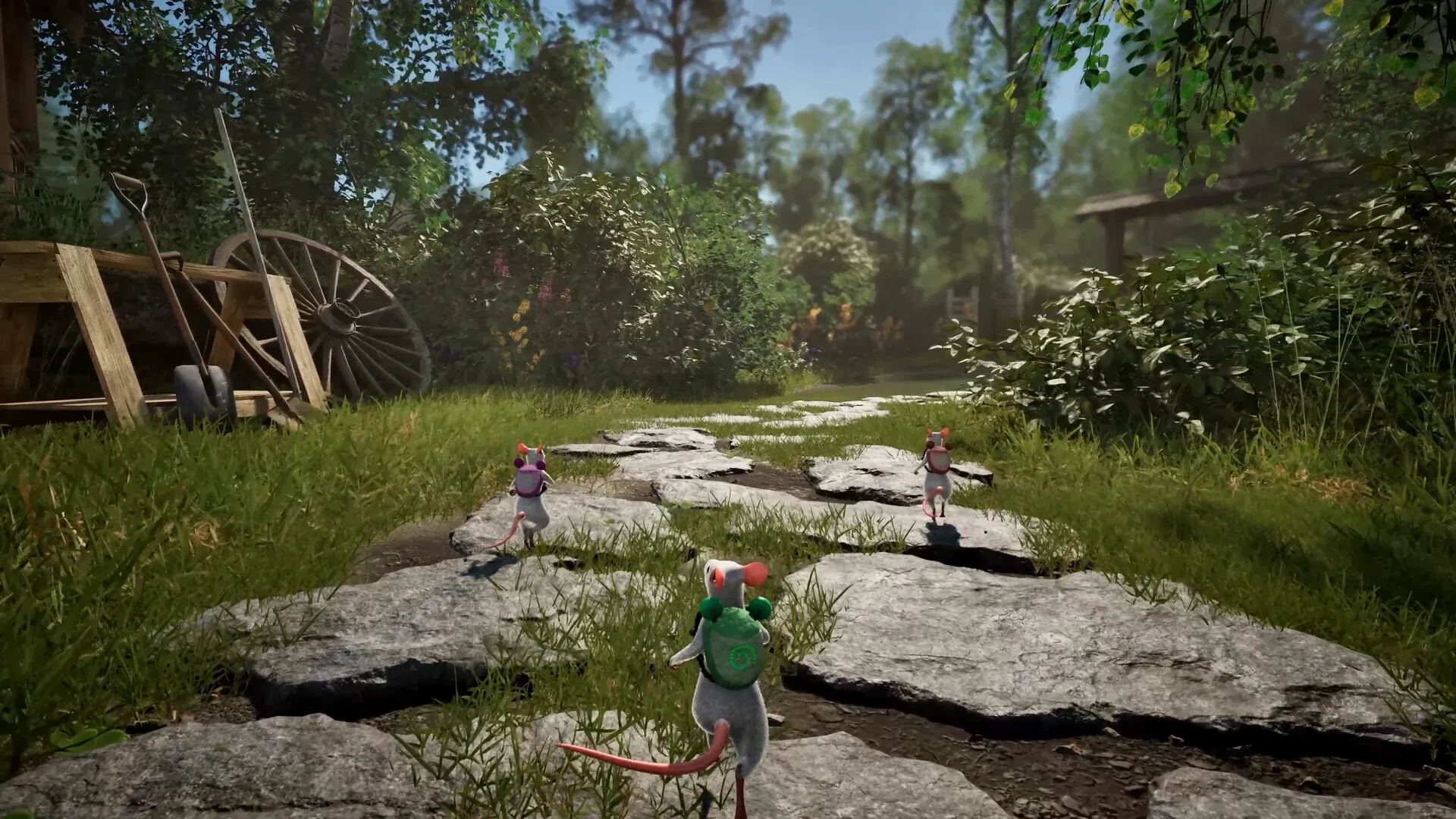
Froggy, the frog-shaped backpack, is the whole movement system. It can grapple and swing, glide, climb, carry and reel a rope. Each action solves a different kind of gap:
- A swing gap has an attach point above or across it.
- A glide gap is wider than a jump but lower than your starting point.
- A climb is a vertical surface with enough stamina in the spiral.
- A carry puzzle needs an object moved, not a jump made.
Spend a few minutes testing all four on safe ground. A player who can tell a swing gap from a glide gap stops guessing, and guessing is what makes a short demo feel long.
2. Treat Shades as a second player, not a menu button
The Shade System creates magical copies of your mouse. They stay where you leave them and keep doing what they were doing. They are not AI companions; they do not walk around or solve the puzzle for you.
The habit to build early is simple: look at a puzzle and ask where a second pair of paws would stand. A pressure plate? A rope anchor? The other end of a tightrope? Once that question is automatic, Shades stop being a special ability and become part of how you read a room.
3. Use a Shade as a checkpoint before a risky climb
This is the most useful beginner trick in the demo. Before a long climb, leave a Shade at the bottom or on a safe ledge. If you fall, swap back to it instead of climbing the same route again. The same applies before a long glide: put a Shade somewhere you can return to, then experiment.
4. Read the ritual card before you start
Rituals are short, self-contained challenges. In the demo, each one showed a goal, a difficulty rating and a mice count. That mice count is the puzzle’s real instruction: it tells you how many bodies — players or Shades — the solution expects.
If a ritual says four mice and you are playing solo, you need Shades to fill the remaining slots. Start by placing the copies where the goal implies they should be, not by running at the target and hoping.
5. Gather on the route, not on a separate trip
Ingredients are part of the exploration loop, not a shopping list. Pick up what is on your path. The demo’s map was small enough that a second pass was cheap, but the full game is larger; backtracking for a single mushroom is the fastest way to turn a pleasant walk into a chore.
Twelve habits that will serve you well
- Look up before you look forward. Hela’s routes are vertical. An attach point above the obvious path often skips the whole obstacle.
- Count the paws. If a door, plate or ritual shows a number, that is your party-size hint.
- Leave a Shade before a climb. It is a save point made of magic.
- Reel the rope. Holding a rope is not the same as setting its length. Reel in to climb higher, let out to descend.
- Plunge deliberately. A ground slam is a tool for breaking through, sinking into hollow objects and launching seesaws — not just a way to land.
- Do not rush the opening. The first minutes teach movement and interaction. They are the tutorial whether they announce themselves or not.
- Forage what you pass. Ingredients are heavy only in the sense that a second trip costs time.
- Treat brewing as the skill tree. Remedies are how the game opens new routes and abilities, not a side activity.
- Reset without shame. Rituals can be reset and Shades can be removed. Experimentation is intended.
- In co-op, assign roles. One player scouts, one anchors, one manages Shades. Four mice running at the same plate is not a plan.
- Follow the letters. The story is delivered through villagers, the witch’s memories and the Ritual Keeper, not a quest marker shouting at you.
- Stop and look. The game rewards pauses: hidden paths, story fragments and small animal encounters are often off the direct route.
Four mistakes to avoid
Expecting combat
There is no combat system to learn. If you are waiting for a weapon, you are waiting for a different game. Your tools are movement, physics and the things you can carry.
Treating Shades as followers
Shades do not follow you. They stay. If a Shade is in the wrong place, remove it and place a new one. The controller mapping puts create and delete on the d-pad for a reason.
Hoarding ingredients
You cannot brew without returning to the cottage, but you also cannot discover a remedy by leaving every ingredient in the forest. Pick up what you find, brew when you return, and treat each remedy as a new key.
Assuming the demo is the whole game
The demo was a standalone story on its own map, not a slice of the campaign. It did not include brewing or online co-op. Its Shade cap, puzzle count and map size are not promises about the full game.
A simple first-session plan
- Finish the opening walk and test every movement verb.
- Find one high place and glide down from it.
- Create a Shade, walk away, and swap back to it.
- Complete one ritual without rushing.
- Gather every ingredient on your route back.
- Return to the cottage, brew if the full game allows it, and read what changed.
That is enough for one session. The forest is not a checklist.
Spotted a mistake or have a better source? The corrections desk is open. This guide is based on official material and labelled previews; it is not a fabricated playthrough.